nyms
All about Mark Levinson
That is the whole of it, really. Everything on this site came out of those two things meeting each other — and if you want the moment they met, it happened twice: once in a room at the back of a warehouse outside Versailles, and once in a book I ordered from an advertisement in a magazine.
So this is not a curriculum vitae. It is the two stories, and what came of them. The credentials are here as well, each one next to the part of the story it belongs to.

I studied theatre and philosophy at the University of Georgia, went on with philosophy at Georgia State, and finished a B.A. in Philosophy at Glendon College, York University, in Toronto, in 1974.
That degree matters more to this story than it looks. Philosophy is not a detour on the way to teaching a language: it is four years of asking how meaning is put together, which turns out to be the same question I have been asking ever since, in a more practical form.
I arrived in France in the mid-1970s and carried on my own education at the Alliance Française and the British Institute in Paris — so I was learning a language at the very moment I began teaching one. I started teaching English in France in 1975, with adult learners: at the Universités de Paris V and Paris VII, at CEGOS, in training organisations and in language schools.
That is the man in the warehouse: an American, a philosopher by training, teaching adults in French companies and doing his own homework in French in the evening.
Early 1980s. A small group of professionals, in a room at the back of a warehouse in the industrial zone of Buc, in the Yvelines near Versailles, not far from the aerodrome at Toussus-le-Noble. Hardly a classroom. It was where the company had space.
At the end of the hour I handed out photocopied exercises to do before the next lesson, as I always did. And one of them asked me the question that I have been answering, in one form or another, for forty years:
“How do we know what's right and what's not?”
What I said was: we'll check them next week. Which was true, and completely inadequate. He would do the work on Tuesday evening and find out on Thursday whether any of it was right — and by then the mistake had been practised twice and learned properly.
What that man needed was an answer at the moment he made the mistake. Not from me: I was not going to be in his kitchen on Tuesday evening. From something else.
And here is the coincidence that started everything. Several of the people in that room worked in the industry that was, at that exact moment, inventing the thing I needed — data storage. Honeywell Bull, eight-inch floppy disks, the machines that came before the 5¼-inch and long before the 3½-inch. I was teaching English to the engineers of the coming home computer, and asking them, over coffee, whether a machine could tell a student he was wrong on Tuesday evening.
They thought it could. So began a search for what I would only later have a name for: automated homework. Everything since — KEYS! on floppy disks, KEYS! on CD-ROM, CampusLingua, and nyms — is that same search, on whatever machine happened to exist at the time.
KEYS! Les clés de l'anglais courant, on three floppy disks, PC and Macintosh
the CD-ROM edition, with recorded sound
Mastering the Basics, Achieving Excellence, Attaining Fluency +
a bestseller, in language schools across Europe
“It was my pleasure to work with Mark throughout the 1990s, when in my role at la librairie Attica in Paris I acted as a distributor of his KEYS! English grammar software. Mark is collaborative, humane, honest, and intelligent, and I give him the highest of recommendations.”
John Carnegie — Vice President Education, DynEd Europe B.V.
The other story begins with an advertisement in The New Yorker, in the 1970s, for a book I could not really afford: a listing of the words of spoken American English in order of frequency, compiled from transcribed interviews with real people.
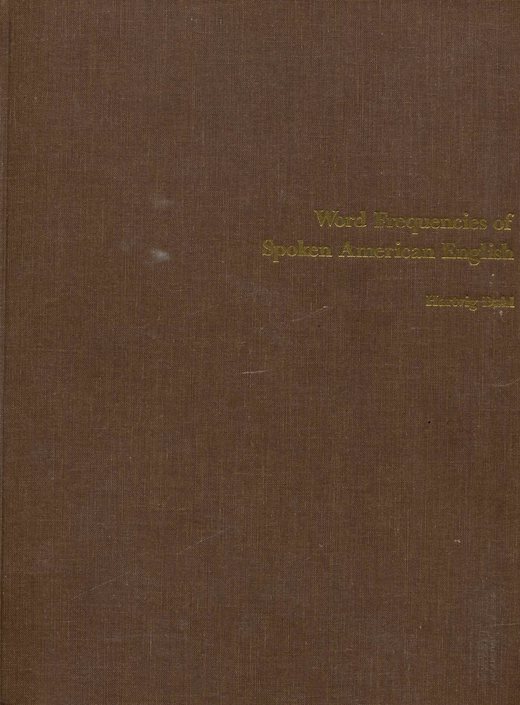
Hartvig Dahl, Word Frequencies of Spoken American English, published by Verbatim in 1979. Not written English — spoken. What people actually say, counted.
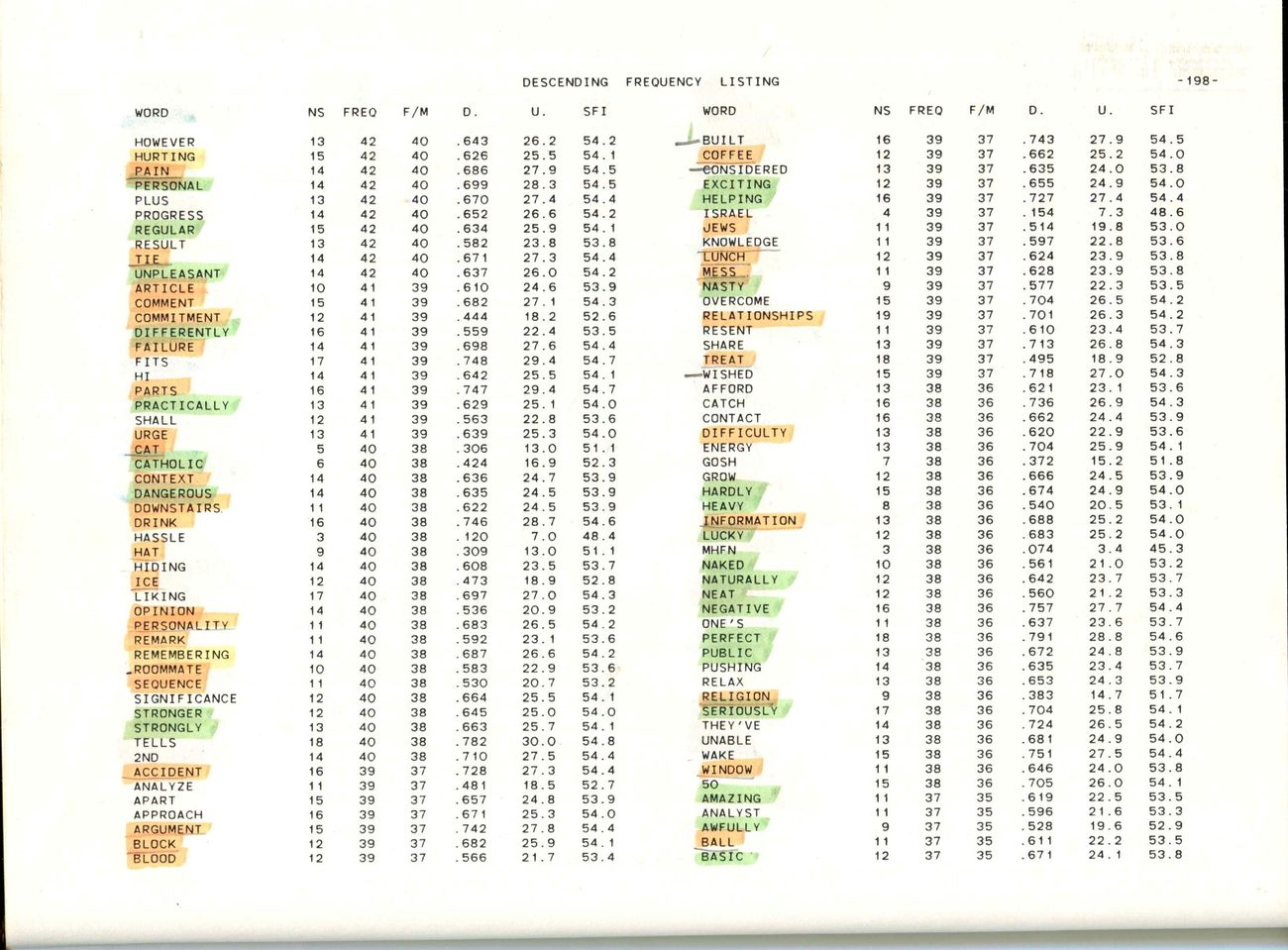
I went through it and sorted the words by grammatical category — nouns here, verbs there, adjectives, adverbs. Then I took the lists into class and gave the students a job that sounds too simple to be worth an hour: put each word in one of three piles. Positive. Negative. I don't know this word.
The third pile told me what to teach. The first two did something I had not expected at all. Because the moment you call a word positive, somebody asks what the negative one is — and there we were, in the middle of antonyms, without my having planned a lesson about them.
And then it gets better, because the pairs will not stay tidy. Today — and the class says yesterday, and somebody else says tomorrow, and both of them are right. Then: what about the day before yesterday? The day after tomorrow? Now they are not learning a list of words, they are handling a small system, in English, at speed, and enjoying an argument about it.
That game was the beginning of Keywords.
It is still in nyms, more or less unchanged in principle: the frequent words first, taken one at a time, with their opposites, their neighbours and the company they keep. The material has been rewritten many times. The idea has never needed to be.
A machine should do the repetition. A teacher should do everything else. That is the whole of my position, and I have not changed it since the warehouse.
Digital learning is not there to replace the teacher — it is there to take back the hour that drilling steals from the lesson, so that the teacher can spend it on interaction, correction, judgement, and the particular difficulty of the particular person in front of them. That was the principle behind KEYS! in 1993 and it is the principle behind nyms today. The technology has changed four times: disks, CD-ROMs, the Web, learning-management systems. The pedagogy has not moved at all.
It is also why teacher development is part of nyms rather than an afterthought. The Master Classes exist to look at ways of teaching, questioning, eliciting language and building mental agility — not to demonstrate software. The tools serve learners through teachers.
The teaching, the consulting and the building were never separate activities. Each one paid for and fed the next.
I founded SECAA in Versailles in 1984 — English programmes for small and medium-sized companies, language audits and diagnostic tools — and then LDB Communication et Conseil in Paris in 1988, which grew into executive training, translation and interpretation, and multimedia development. That is where the range came from: advertising and design, finance, medicine and research, hospitality, luxury, information technology, law, accountancy, public institutions.
In 1999 I founded CampusLingua SA in Paris, a B2B portal meant to connect learners with providers of language training, with a European and transatlantic network around it. It anticipated a good deal of what became ordinary later. In 2012 I came back to the same problem with CampusLinguaOnline, an English-learning system built around blended learning — its architecture, its design, its content and its LMS structure. Blended learning, before the term was in general use, is only the warehouse observation again: the computer and the teacher should not be doing the same job.
None of it stopped the teaching. I went on designing and giving courses throughout — specialised English for the Paris GRETA system, and work as a learning consultant with Intervenance, where teaching, e-learning, copywriting and translation all belonged to the same job.
EFL instructor and course creator, Continuing Education and Development Department, École Normale Supérieure de Cachan.
Preparatory programmes for students sitting the entrance competitions for the Instituts d'études politiques and for journalism schools.
International MBA, IAE / Université Paris I Panthéon-Sorbonne: Communication and Negotiation, Public Speaking in English, and my own course, Faster Thinking in English.
“Mark Levinson a été un excellent professeur d'anglais et de culture générale anglo-saxonne. Mark m'a grandement aidé dans une préparation sérieuse et rigoureuse aux concours d'accès aux Instituts d'études politiques. Je recommande son travail méthodologique et sérieux.”
Pierre-Jean Verrando — Director General, Digital Security Industry, Eurosmart
A growing part of the work became individual coaching, and the distinction matters more than it sounds.
Preparing an executive for a conference, a television appearance, a negotiation or an interview. Getting a researcher ready to present or publish internationally. Working with someone whose real obstacle was confidence and not vocabulary at all. The teaching supplies the language; the coaching is what makes it available under pressure — which is the warehouse question once more, met one person at a time.
That work took place at Rothschild, LVMH and Christian Dior Perfumes, Assistance Publique – Hôpitaux de Paris, Club Med, Accor, IBM, Deloitte and Shiseido, among others.
“Mark has a wonderful rapport with people of all ages. His ability to connect with his students and his talent at teaching basic, as well as advanced topics, are both truly superior. His excellent written and verbal communication skills have helped me in my publications and professional presentations around the world. I recommend Mark to you without reservation.”
Jelena Martinovic — Fetal Pathologist and Geneticist, Assistance Publique – Hôpitaux de Paris · student since 2009
“Mark est bien plus qu'un simple professeur d'anglais. Sa méthodologie d'enseignement attise autant la linguistique que la vivacité d'esprit. Mark a une excellente connaissance du monde de la création, étant d'une grande culture et curieux lui-même. Il coache de plus à merveille pour les interventions en public. Merci infiniment Mark !”
Romain Paty — Directeur artistique
“Les leçons de Mark m'ont été profitables pour préparer des interventions orales et écrites en anglais — réunions de travail et conférences données à l'étranger. J'ai beaucoup apprécié sa capacité, en tant que coach.”
Michel Diaz — Owner and Associate Director, FEFAUR
“Mark is a brilliant English coach. Thanks to his courses, I improved my English speaking but also discovered the American culture. He is both talented and creative in his manner to teach us English.”
Tia-Tun Yen — Manager, Deloitte Consulting
That is where the two stories arrive. The warehouse gave me the machine; the word-frequency book gave me what to put on it; the coaching told me what the goal actually is. Not more English. Faster, surer access to the English you already have.
Because vocabulary is not a list. A radish belongs to a category. Buy is not far from sell. Deep reaches for shallow. A glove is to a hand what a shoe is to a foot. Words carry their opposites, their categories, their parts and wholes, their functions and their consequences with them — synonyms, antonyms, hypernyms, homonyms. The -nyms. That is where the name comes from, and it is what the whole site is made of.
One more thing I will not compromise on, and it comes from the same instinct as the highlighting on that page: every voice on nyms is a real person, recorded. Never a synthetic voice. Mine, and Sarianna Gregg's — you can hear her, and see her, in the Video Lab on the front page, where the lab draws her melody against yours.
“I have worked with Mark on several fascinating projects involving language and bilingual learning. He is creative, inventive, receptive, and an absolute joy to work with, and to know. Mark has inspired me personally to trust my talent and creativity... He recognizes, encourages, celebrates and believes. So he makes you believe. And he is unfailingly positive.”
Sarianna Gregg — Voice Actor, Sarianna Gregg Voice-Overs
Fifty years, and the question has not changed once: how do we help people use what they know — better, faster, and with more confidence?
For anyone who wanted the credentials on their own, after all.
American and French dual citizen, bilingual English–French, in Paris since the mid-1970s.
Theatre and philosophy, University of Georgia; philosophy, Georgia State University; B.A. in Philosophy, Glendon College, York University, Toronto, 1974.
1975 — nearly fifty years in and around the English language, almost all of it with adults in France.
SECAA (1984), LDB Communication et Conseil (1988–2000), CampusLingua (1999–2006), The Paris Savannah Company (2008–2017), CampusLinguaOnline (2012–2017).
Université Paris I Panthéon-Sorbonne (International MBA), École Normale Supérieure de Cachan, SEFICO, GRETA, and Sciences Po preparatory classes.
Rothschild Bank, LVMH and Christian Dior Perfumes, Assistance Publique – Hôpitaux de Paris, Club Med, Accor, IBM, Deloitte, Shiseido, among others.
KEYS! Les clés de l'anglais courant (1993–1998), and Better and Faster Thinking in English (2015).
Co-chair, Education and Training Task Force, American Chamber of Commerce in Paris (2012–2016). Board of Directors, Association of Americans Resident Overseas.
The Paris Savannah Connection, a blog on language and life between Paris and Savannah, since 2010.
If you teach, if you run a language centre, or if you simply want to know whether any of this is for you — write to me. It reaches me directly.
Get in touch