 Log in
If you do have a teacher or coach, that's wonderful. Your teacher has the training and experience and deep knowledge necessary to provide you with the insight and guidance you need, when you need it. That is something human and something no pre-prepared courseware can ever do!
 can help you practice 24/7, at your own rhythm. You’ll learn a great deal here. You’ll enrich your active vocabulary, grammar and syntax. You’ll improve your memory. You’ll learn to explore and discover Standard American English, both through focused listening and pronunciation and intonation exercises throughout the site. And I hope you’ll develop a real feeling of self confidence when in the company of others — no matter where they’re from.
What happens afterwards is where comes in. On your own, between your live sessions, you practice if you can find the time to do so — and then you come back to your teacher having improved in the meantime.
You won't learn to play the piano without a teacher and without practicing. The same is true of playing tennis, and of every sport, every skill, every art. Teacher & practice. It is true of languages too — even your own. Practice makes perfect. That’s the proverb. And by the way, when you’re learning to play the piano, unless you’re a re-born Wolfgang Amadeus Mozart, you’ll probably need some written music, won’t you? And if you want to play tennis, you’d need tennis shoes and a racket. Well it’s a pretty good idea to have a dictionary nearby when you’re learning a foreign language. And they are an indispensable resource. With the advent of the internet and the digital era, there are now online dictionaries, too? And very good ones. But is a little special. Here you have access to a living LEXICON, a bilingual sound dictionary containing about 12,000 entries, with headwords, in-context examples, and voice recordings to hear and to practice, thanks to our online language lab with exceptional voice recognition tools.
Meeting the language, understanding it, seeing how it behaves. This is what a good teacher and a good course do well. You assimilate sounds, meanings, spellings, intonations, and even connotations as you encounter other people, even media. How? Reading, listening, sharing. And nyms offers you so many opportunities to learn.
Using it yourself, out loud and in writing, over and over again until it costs you nothing. Until it becomes natural and effortless. This is what nyms can help you with. It might be a functional word like above or below compared to under and over, or the spontaneity with which you ask questions or make comments, understanding any of the multitude of everyday expressions used by millions of people.
You can manage, even very well but that’s still not good enough. You’d love for your English to be up to the same high level as your French. The language we use is like the clothes we wear. There’s a question of style: casual, business, formal. There are questions of social decorum. Perfecting your English is being able to use nuance. Being able to respond appropriately using your own intelligence, your own life experience. nyms opens up doors to help you perfect your pronunciation, your mastery of vocabulary and concepts, your ease to interpreting what others have to say.
I really really would love to speak English fluently!! I don’t have so much time but I CAN find 15 minutes or half an hour, if not EVERY day, at least often. I need to learn more vocabulary and review my grammar. If it’s fun, I’ll be motivated for sure! In fact, I love traveling and meeting new people. Sometimes, I read books in their bilingual versions and I do go to the cinema pretty often. If only I could understand all the Beatles’ songs…
Join — or ask me firstI love language and I love teaching! And I think my students show their appreciation for the ways I use to get them to say what they want, to help them integrate new vocabulary with fresh ideas. While English is the goal and the medium, I don’t ban French from my classes. I’d love for my students to think bilingually! What’s needed? Practice between classes and travel!
Become a partner — ask me! There are interesting perspectives on the horizon.I’m on the HR staff at a company that works with people worldwide. Some on the payroll are perfectly fluent in English and some in Spanish, too. Others less so. Part of my job is to provide continuing education to our colleagues. English language courses are fundamental here. And one of the biggest challenges is finding the time to attend classes. Blended learning is the ideal solution for us. One-to-one and group sessions and online support systems that are available 24/7.
Start a conversationLet me know what interests you and how I can help!
Write to Mark →Antonym, synonym, homonym, hypernym hyponym — a word has meaning through its relations to other words, and those relations are what nyms brings you. This is how we think. We think through comparison, comparative reasoning and through analogy: the words ‘like’ and ‘unlike’ are vital!
Because your time in class or with others is limited. nyms provides those opportunities 24/7. With good vibes, and quality talk. Quality games, quality resources.
Because one of the ways to fix a word's meaning is to find what it’s not. Words like “hot” indicate “not cold” “here” means “not there” “mine” means ‘not yours’
And it’s with antonyms, opposites, that we begin. Because words mean, first of all, what they’re not. The nyms collection of antonyms are derived from studies of the most frequently used words in modern English. And it is from these words that we have a starting point to fill in the gaps in our vocabularies. A vocabulary that grows in pairs grows twice as fast as a vocabulary that grows in a list.
At the heart of these different English language courses and activities lies the notion that when we think words, we think concepts, most often unconsciously. It is this very fact that leads us to uncover latent language links and to discover new ones. Language is a cognitive activity. And the very concepts that make up the human experience are fundamental to our command of the language. There are universal concepts and more localized ones: nationally, regionally, locally. Language and thought are yours to explore!
In practice: two opposites are always arguing about something — hot and cold about temperature, generous and stingy about generosity — and that something is the shelf the words sit on. Own the shelf and you hold a whole family of words at once. It is also what rescues you in mid-sentence: when the exact word will not come, a speaker who has the concept goes around it and keeps talking. A speaker who has only the word stops.
Because vocabulary is more of a memory problem, than an understanding problem.
Recall is trained by being made to retrieve, not by being shown the word again. A word presented three ways at once — heard, read, and known in your own language — has three roads leading back to it instead of one.
KEYS is a metaphor. Literally, they open doors. But they also open doors to new knowledge, to new learning, to new skills. Without the keys, you’re locked outside. The Keys in nyms are the proven ways to master the grammar and syntax of modern everyday English.
Vocabulary is essential to express yourself, to understand others; syntax makes you respected. It is the part adults are most often quietly ashamed of, and the part that a few thousand questions will quietly fix.
If the “on” card further up caught you out, this is the course that does something about it — the chapter below is called “on, over, under, above, below”.
The best “between classes” quizzes you’ll ever encounter.
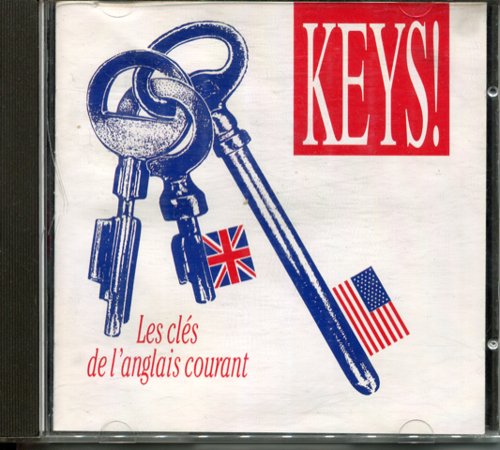
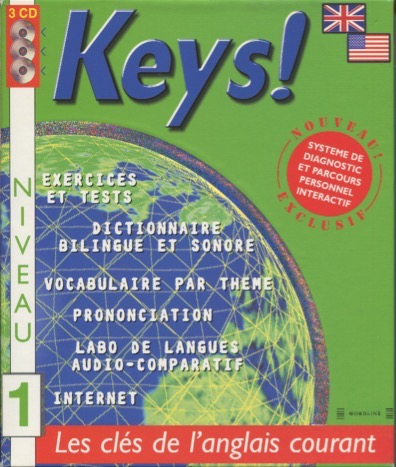
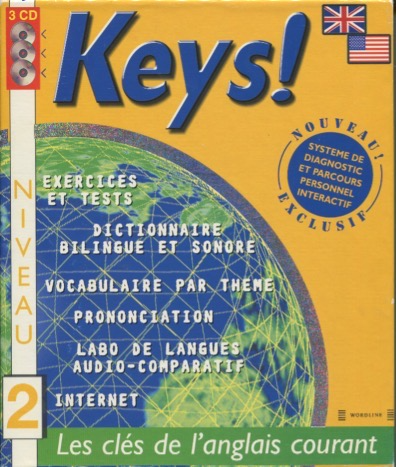
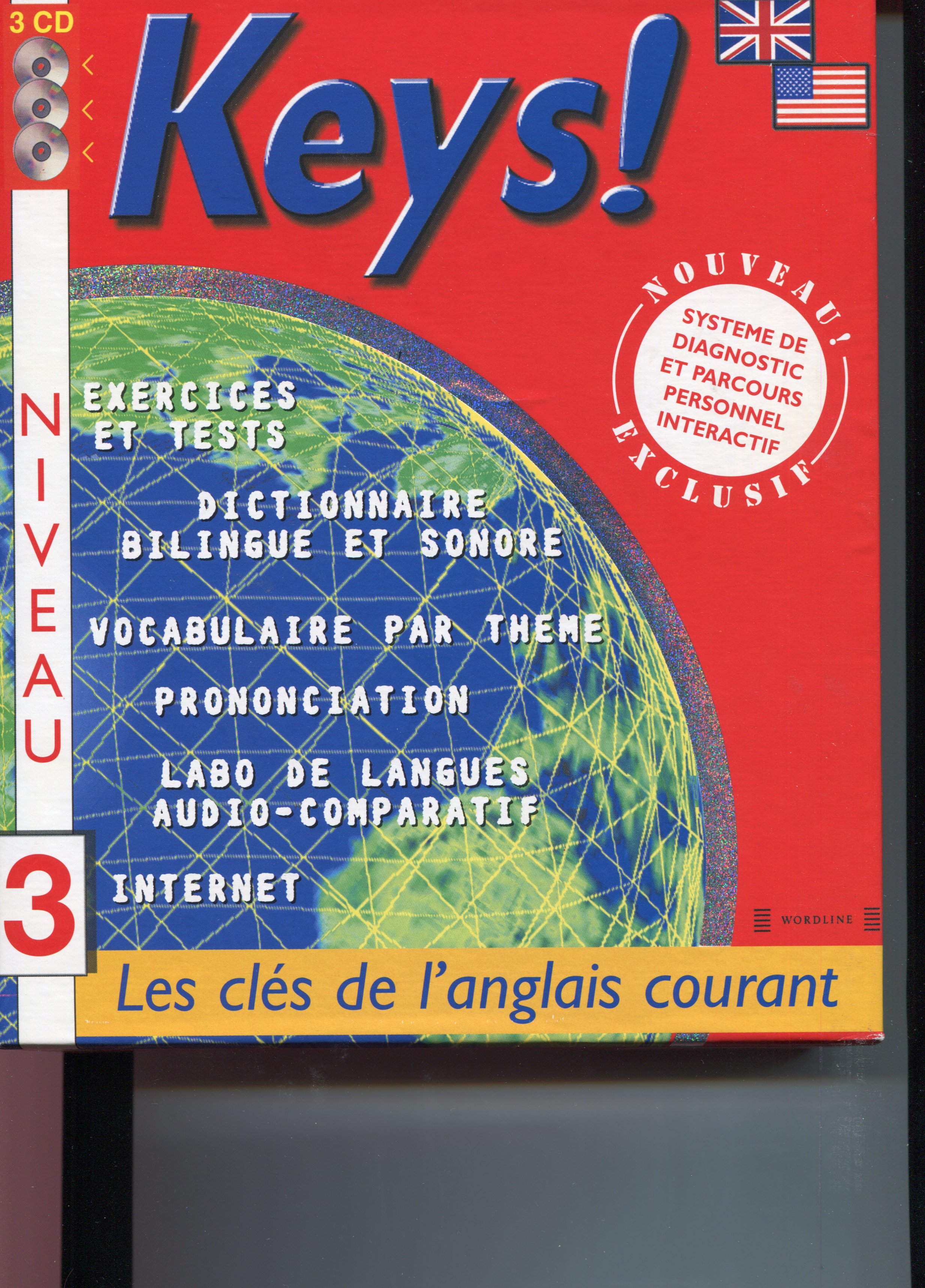
KEYS! was a published course long before it was a website — KEYS! Les clés de l’anglais courant, three levels, three CDs each, distributed professionally and used by hundreds of language schools and continuing education programs in France, Belgium, and Switzerland. We’ve now brought KEYs! up to date! Enjoy it!
Want to see how nyms helps you practice? Here is one sample of each kind. Pick any of them — it opens right here, and nothing asks you to sign in.
Feel free to click on the icons below to see what sort of content is on the full site!
With an online teacher’s forum, teachers are able to discuss any issues they like with each other in the privacy of a secure space. They also have ready access to resources like the CECRL publications and online assessments as well as a bibliography.
One word, one task: find its opposite.
reluctant
Why?You fill in those gaps in your Mental Lexicon immediately as you think in English.
Two opposites appear. Name what they are opposites about.
generous / stingy
Why?While opposites come in pairs; concepts turn those pairs into a network. Once you know that hot and cold are about temperature, you have a mental space to connect new words!.
No options this time — type the opposite.
on
Why?The small words carry the most meanings and cause the most trouble, precisely because they were learned in week one and never looked at again. This is why nyms teaches words through the concepts they carry. Like DNA.
The same 840 expressions in five languages. An English expression, three candidates — only one of them is the real translation, and the clock is running. The candidates come in French, Italian, Portuguese or Spanish, whichever language you think in.
Bilingual Thinking will keep you on your feet.
“I'll get back to you.”
Why?Against a clock you cannot translate word by word; there is no time. You are pushed into matching whole thoughts instead, which is what bilingual people actually do.
Nine cards, three words. Each word is here three times over: once as a sound, once in English, once in French. Find three that belong together.
Why?Three routes to the same word at once — heard, read, and known in your own language. A word reached by three roads is far harder to lose than a word reached by one! Have fun!
Listen once, then type back what you heard. Not what you think it should say.
Why?Listening and writing at the same time is the one exercise that shows you the difference between what was said and what you assumed was said. I know it’s fast!
Seventy keywords, and three spaces to each one: what it stands against, where you would reach for it, and what it belongs to. Nothing is marked — there is no answer key, because the list is yours.
right
Nothing built yet. One entry per box, or several separated by commas.
Why?A word you can actually use never arrives alone. It comes with the word it stands against, the phrases it lives in and the idea it belongs to — and that is what makes it surface when you need it, instead of three seconds too late.
The same question as the one you started with, without the four choices. This is the version that counts.
the opposite of scarce
Why?Recognising a word and producing one are two different abilities. Multiple choice trains the first, and conversation demands the second. When the options disappear, you find out which one you actually have.
Both a game and a course. These Master Classes will open up worlds of insight into language and provide you with stimulating content for all age groups.
wonderful adjective · A2 · formidable
Why?A learner needs a word to be usable. A teacher needs the whole picture behind it — where it came from, what it excludes, which near-neighbours are not interchangeable with it. The Master Class is for experienced teachers who recognize that innovative pedagogy can be beneficial for everyone. Guananteed success.
Getting Good and Getting Better, chapter 31: “on, over, under, above, below”. Sixteen questions in that chapter alone. Here is the first one, unchanged.
The photographer's favorite subject was nature: the sky , the earth
Why?Prepositions and adverbs are everywhere. They are learned by having met them a few hundred times in a sentence that made sense. One chapter here holds sixteen questions on five of them; the library holds more than six thousand.
The same chapter, written out in full — once for the learner, and once for whoever is teaching it. Both already exist for every chapter in the library.
Why?This is what separates a set of exercises from a course. A learner wants to know why. Wants reasons. Here they can read why, both in English and in their own language. And a teacher opening this chapter finds the level, the timing, the objectives, the mistakes their class is about to make, and a sequence to follow — already written. That is the “ready-to-wear” preparation a teacher can use as is or build upon.
11,191 English headwords with their French translations in context, each one carrying its grammar, its frequency, its CEFR level and an example of current usage. Here is a single word.
right nine separate entries in the Lexicon, for this one word
Why?The nyms Lexicon gives you which sense, how common it is, what level it belongs to, and an example in context with the word doing its job — spoken, so you hear where the stress falls. Nine entries for right is the difference between the word you recognise and the word you can use.
This is how it works on nyms itself, on any word or example in the Lexicon.
“Right away!”
Listen to the speaker, nothing artificial here, then record yourself and compare the two shapes.
Shared time axis. Each take is scaled to its own loudest moment, so this compares timing and stress.
Why?You cannot hear your own accent from the inside — that is the whole difficulty, and no amount of listening fixes it. Drawn on a shared axis, the difference stops being a matter of opinion: you can see where the native voice lands hard and where it lets the sound fall away, and whether yours is similar.
Watch Sarianna say a line, then say it yourself. The lab draws both melodies — hers and yours — on the same axis, so you can see where your voice rises and falls against where hers does. She says it five times, and not identically: the same words carry a different tune depending on who is in the room.
🔒 Your recordings never leave this device. Nothing is uploaded, nothing is stored on any server, and nothing is written to your disk — your takes evaporate the moment you close this page.
“Nice to meet you.”
The melody — the pitch of the voice, rising and falling — not the loudness. Each line is drawn across its own phrase, so what you are comparing is the shape of the tune.
Why?Melody is the part of an accent nobody teaches, because it cannot be written down. A sentence with every sound correct and the wrong tune still sounds foreign, and the speaker has no idea why. Watching a face say it, then seeing your own line drawn against hers, is the shortest route to hearing something like itw as the first time!
A conversation partner that talks with you and never interrupts to correct you. Pick your level, A2 to C2, pick a situation, and choose five nyms expressions to work in. The full debrief comes at the end.
Why?Conversation is the one thing a course cannot give you enough of, because it needs a partner with time and patience. Here you have both, at any hour, at your own level — and because nothing is corrected while you speak, you keep going instead of freezing. The corrections wait until the end, where they can be read calmly.
And this is the one thing on this page you cannot try in a browser, because it is a person.
Why?Everything else here is practice you do on your own, where repetition has to happen. But at some point you have to say it to somebody who will answer — who will hesitate, interrupt, misunderstand you and make you try again. That is not a feature anyone can build. It is an hour with a human being, and it is where the practice turns into speech.
Fifty years of experience with thousands of adult learners and students, and a team including a lexicographer, teachers and programmers. A precursor of automated homework, and a best-seller to hundreds of language schools, public and private, across Europe.
nyms is the work of Mark Levinson, an American who began teaching English in France in 1975. nyms is the result of a lifetime of experience working with French adults and students in their quest to speak better English, read faster, understand more efficiently and … to think in English.
For more about Mark, click here.
of teaching, writing and recording, gathered into one place
not a word of synthetic speech!
grammar and syntax questions, with bilingual guides
aligned to the Council of Europe's CEFR levels throughout
And it's all yours for:
The grammar and syntax library, the games and the Lexicon.
Everything above, plus the courses and training in the Master Class material when you enroll 30 learners.
Everything, plus live video sessions with Mark once a month.